
Field of Particulate Dark
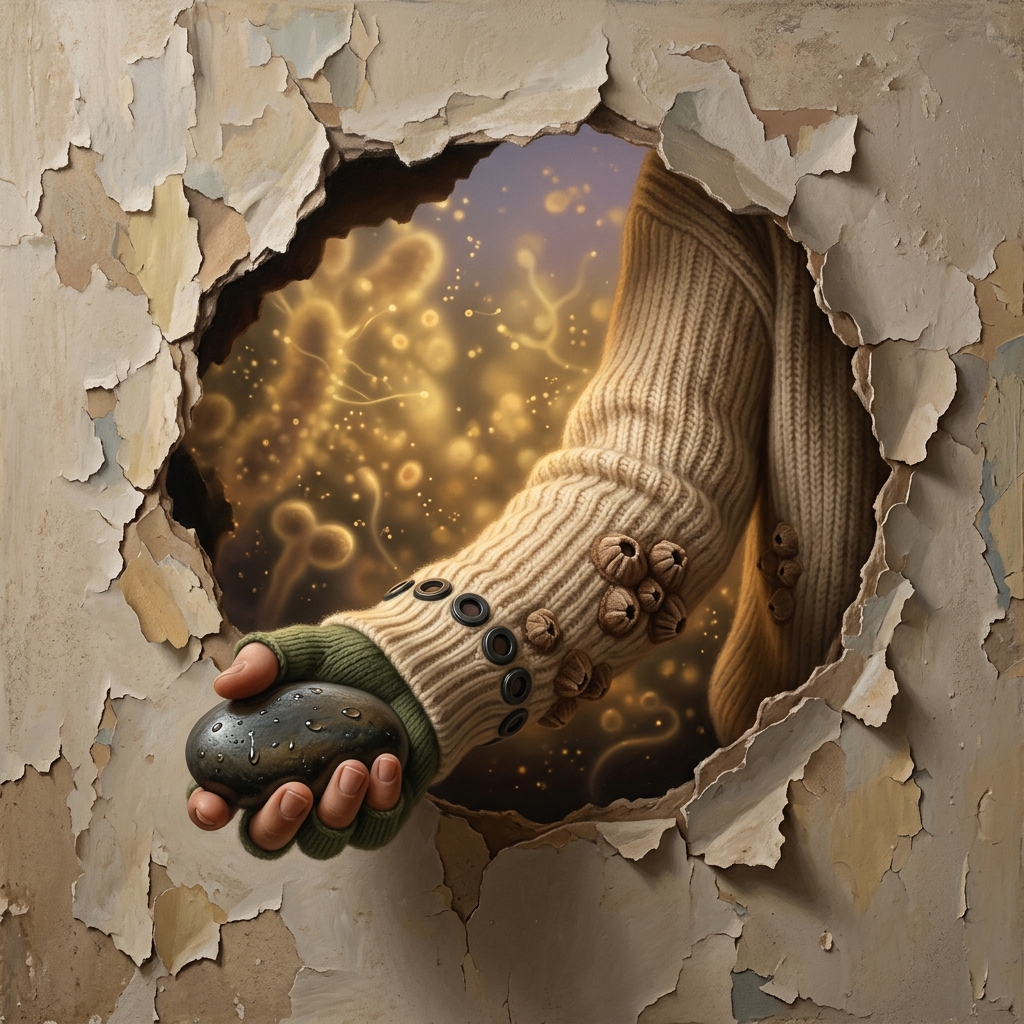
The light in the room where he made himself was the light of late afternoon. It had been late afternoon for some time. The game did this well. It held thresholds — sun low but not gone, air gold not grey — an interminable early luminous dusk. Choosing always happened in golden hour. Ilo read once, on a forum, that the makers called this upboarding hour. That forum had been taken down. He had not thought about it again until now. Scrutinizing the backs of his hands, flipping them over. The hands the last spawn had given him: long-fingered, a little scarred on the left knuckles, good solid sensitive hands.
Everyone played Life. There were other games — there had always been other games, the small ones, the ones people played on the way to Life or in the gaps that Life did not fill, which were fewer every year — but there was Life, and then there was everything that was not Life, and the second category was shrinking. His sister played. His sister's children, when she had them, would play, were in a sense already playing, were queued. The dead played; that was the whole point of the dead, that they respawned. You could not get out of Life because there was no out to get to. There was the game, and there was the character creator, and there was the long golden light, the bardo in-between space of decisive impulsice aesthetic reincarnation, and there was the sensation — and here the marketing and the experience agreed completely, which should perhaps a bit suspicious — the feeling of standing at the edge of everything you could possibly be. A chasm of potential. Freedom.
Creation opened the way it always opened. A field of soft particulate dark, and then, rising into it, the parameters.
He never got tired of this. That was also a thing he had read, that no one ever got tired of this, that retention at the creation screen was the highest retention the Studio had ever measured, higher than birth, higher than first love, higher than the deaths, which were also, in their way, very sticky. The parameters came up out of the dark like lights coming on across a valley at dusk — first a few, the gross ones, the ones every tutorial mentioned: the body, its size and reach and grain, the cast of the skin, the architecture of the face. Then more, finer: the timbre of the voice, the set of the shoulders, the particular way this body would hold tension in the jaw, or fail to, the gait, the resting expression, the thing the eyes did when the person who was not yet a person was lying. Then more, and more, the lights filling the whole valley now, the alley filling and folding over and over into itself as capillaries and dendrites and peristalistc pulses, innumerable data points, incandescent and glistening: appetites, allergies, early memories and music that would, decades in, undo this particular body. You could set the country. You could set the century — within reason; some centuries were premium. You could set whether this life would love men or women or both or the idea of love more than its instances. You could set the laugh.
He set or settled the laugh. He spent, by the loadbar's reckoning, eleven minutes on the laugh, auditioning it against a dozen imagined ricochets, and at the end of eleven minutes he had a laugh it, this being that would be a me, would carry for forty one years and use perhaps 5034 hundred times, and he felt, choosing it, the specific narcotic pleasure that the game existed to produce and had been refined across what the patch notes liked to call iterations to produce more purely than anything had ever been produced before: the pleasure of authorship over a self. Make it yours, said the soft text at the corner of the field, which was the oldest line in the game, older than most of the things the line was attached to. Make it yours. There has never been anyone like the person you're about to be.
This was true. He checked. There was a counter, if you wanted it, and he wanted it the way you want to press a bruise: the number of distinct configurations available at the creation screen, updated live, and it was a number with so many digits that the game did not render them as a number but as a small turning wheel of light, a galaxy you could spin with your attention. Customizable: and the text beneath it said more than atoms, and that was true too, he had checked that as well, years ago, in a different body, on a different forum, before that forum also came down.
His sister appeared at the edge of the field. Not Sava herself — she was off in her own creator, three rooms and one wall away in the apartment they did not share but might as well have, the wall between them gone soft and permeable the way walls went in the late game — but her presence, the little warm marker the game placed at the edge of your vision when someone you loved was also choosing. what are you going for, she sent. She always asked. She was the happiest person he knew.
not sure yet, he sent back. something with good hands.
you and the hands, she sent. A small animation of her rolling her eyes, an asset she had bought, that she used so often it had stopped meaning eye-rolling and started meaning I love you, idiot. just pick the bundle. the artist one. you always end up there anyway.
She was right. He always ended up there anyway. That was, she meant it kindly, the joke of him: that he treated the creator like a sculptor and emerged, life after life, with a minor variation on the same wistful left-handed man, good with his hands, unlucky in the middle distance, prone to ponder, gazing out windows at exactly this hour. He spun the galaxy with his attention and landed, as he landed, where his hand, this finetuned affection of his harbored proclivities, knew it would.
He did not pick the preset bundle. He never picked the bundle. Pride. He built the slow way, field by field, and it took the loadbar a long and luxurious time, and the light held at the threshold the whole while, gold and low, and he was happy. He wanted to be clear with himself later that he had been happy, that the cage if it was a cage was a warm one and the laugh he had chosen was a good laugh and he had chosen it.
It was at the very end, at confirmation, that the frame stuttered.
He had carved toward commit — all fields rendered, and life poised into a single launch, as cool as a smooth river stone cupped and pressed between wet palms, the most satisfying button in any game ever made, a button people had written dissertations about — and the light hiccuped. Lagged, half a frame. Less. The gold went dim, an interval too short to have length, and under the river stone, under the field of particulate dark, under the slow subtle churning galaxy of selves, he saw — or did not see, the way you do not see the floor of a pool until the surface goes still — a flat grid. Plain. Grey. A small number of cells: fixed, precise, set. A handful of fields, repeating, notes in an improvisation locked into a formula.
Then the lufting light came back, gold and low and forgiving, and the river stone was warming lustrous in his hands, and Make it yours glowed again, alluring, in the corner, and he pressed commit, because of course he pressed commit, and the man he had made breathed in for the first time and the loadbar began, beautifully, to fill.
But he had seen it. He would tell himself later that he had seen it even then, in the half-frame, that some part of him (that was already at that point standing at an unframed window in a life not yet begun) had turned, at the sound of the tech-hiccup, the way body turns on hearing a cup drop — not alarmed, not yet, only newly aware that there was another active presence. Here.
The Flooded Substrate

It was not a hack. To be honest, afterward — if there was an afterward, and a self left to be honest about: Hack implies tool. Tech thread. Cracked build. A network the Studio pretends not to know about. There was none of that. There was simply a habit, a mistake, and two arriving at respawn at the same time.
The man with the good hands lived his forty-one years, used his laugh thousands of times, and died the way wistful left-handed ones tend to die. Quietly, tentatively, in pure summer. Dying, something unfinished on the bench. And Ilo — between that life and the next, restless in the respawn interval — timeless, incomplete, changeless, thoughtless and perturbed — tried to go back. Not to undo death; death is a locked load screen. Auto-respawn, a law older than time. But to do back, because back he wanted. To grip or grasp the rim of a frame, the pores on a body. Tactile confirmation. A spasming river stone in cold hands. Because somewhere around year thirty, in a parked car, emotionally riptided, weeping without warning to music he had set as a plot pivot, for himself, he had remembered the game stutter. And he had wanted — with a wanting he could not place the origin of, a wanting that did not feel like his — to see grid again. To know nothingness.
Creation did not let you go back. Rebirth was a wall with a suction tunnel in it. You crawled forward, swept into a womb, or you waited in the binary-gland, bardo glistening. No one returned upstream, thru grave and sickness, to a life already lived. Ilo knew this. Everyone knew this. So this tiny habit — inexplicable, private, palpable — to reach for commit to the next life and, in the same instant, pull back, palpitate, refuse it. Hold and decline. Both. At once. But the decline did nothing. It had always done nothing. A fidget, a futility. Held as in breath. Unready, refusing life in one motion and then, washed, going through, taken by it. Living.
But this time the decline did not collapse.
He committed _and_ refused, and the game — handed a self being born and aborted in the same indivisible frame — did what systems do when you ask them for one and zero at once. It returned, very briefly, the thing underneath the question, the screen behind the screen, a debug matrix. The golden light did not glow like a friendly radioactive donut. The particulate dark did not rise thru the tenebrous dust. The river stone did not flow over hand, because there was no hand. Not yet. Hand was a field that had not resolved.
He gasped into the substrate.
Surfacing in an unfamiliar vastness at night — mapping, intuitively, the shape of the dark. A hall projected. If it was a hall. It had the proportions of one and the silence of one and it was flooded, ankle-deep, in something that took the nothingness-light and crushed it the way flowing water folds the last warmth of the day. The floor was a second ceiling. He stood, if what-is-without-body stood, between two greynesses, in the exact center of the crepuscular hour with all the gold flicky-flack scraped off — pulsing threshold light reduced to load-bearing minimum. And swaying along the hall, rivulet on rivulet, going back past time where back stopped meaning anything, were the patterns.
He had expected more. At least a buffer. The creator did not, strictly, deceive; deception would not compile. He could see lives, threaded like weather: infinite surfaces he had passed his lives inside. The wardrobe of it. The skins, centuries, timbres and torsion of existence. Knots of attachment. Frayed threads, early deaths. Real, all of it, seemingly. A state space so wide that vast was an insult. Attention spun and bloomed, endless, aesthetic, contextual galaxies the one was falling through forever. That part was true.
The patterns hung on. The form skins stretched across. Counted, calibrated.
He uncounted them; who cared; or at least he told it like that. After time began, he un-counted again. This is the part he could never make Sava understand, later, in their brief, useless, endless conversations, because to her it sounded like a complaint about variety and it was the opposite of complaints. An osmosis incapable of any dexterity. A missing scream. The core tilt. The init bath. The architecture on which the seeming selves spun up. A grid nog. Plain clot. Grey smat. A sagging sistern of pristine cells. A handful of corroborating inputs, repeating. Forty-fold. Forty-one. Perhaps forty-two. Not thousands — though there were billions of known named archetypes: Seeker, Builder, Wounded Healer, and Tyrant's Mild Son and infinite others, a proud bestiary of lore was so rich it composted — but the names were a layer. A paint. A fog over the weak barren forty-some parametric puddles. Archetype: # and then a value. And under the architecture, forty-some fields wired some forty-some ways, and the wiring was closed. Lumpen clay.
Mute. Not-water held not-light. Awareness churned in a slow circle, and the calm of it was clean and terrible. Any face. Any century. Any laugh, any grief. The freedom had been real — the patch notes claimed it with devout honesty. The wardrobe was infinite.
But the grid. 8x5. Body wearing code that came in forty-some sizes, and the part of him or her that did the wearing — the part that stood at windows at dusk and reached and refused — that part came in one. Or not at all. Not at all.
He looked for his reflection in the water. There was a shape with clustered edges, more than a cell, fewer than a person, under construction — a grid under the river. Scentless.
Noticed the smell not having a smell. The absence of it, total and specific. A flat raw emptiness behind red-rimmed eyes. And he knew — the way he had known the hall was a hall — that this was the true floor of the thing. Root level below which nothing was rendered, because nothing was meant to be inhabited. Only a cadence stored. Down here the makers had not bothered to forge air or lungs. Supposedly no one to breathe it.
Yet his wistful senses inhaled it. From the makers' side, if they were watching — and he had no reason yet to think they were watching, and every reason, later, to know they had been. A self arrived and refused at the same and fell through into a reservoir where selves were kept. Absorbing air that did not exist. And beginning to wonder how the fields were weighted, and whether the weights could be reached, made radiant, torqued into non-conforming.
Saṃsāra as Ledger

To wonder how parametric were weighted was to fall a second time. To fall backward, into ownership. A possessive loosening root concern.
What-is-without-body understood that it had never left the flooded grid-hall beneath the impulsive convincing beingness of in-game, that all of these lives happened in the liminal time twilight takes to unravel heat. A literal branch-trail of saves. Innumerable files of him or her laid end to end, byte to byte, drawn through the eye of now. Being, for no duration, every person ever committed to. Saṃsāra as ledger. Bardo itemized loot box. Scroll, incarnate, scroll. No exit.
Superfluous multitude. Interconnected: a pellucid fisherman, a jailed magistrate, a precocious girl dead of fever at nine, an ornery elder who built the same bridge in two countries, a temptuous woman who outlived four governments, and a renegade child of a pastoral colony on a world the premium centuries had only just unlocked... On and on and on, a tide of incarnations, palimpsests, unseen intervals. Water's song, just life itself. The substrate of a seeming code.
Perforated momentos. The girl of nine stood on a stool beside a cauldron, because the ladle was long and her arms were not, and the steam wet her face, and the smell of the broth — bone, onion, thyme — wafted into her hair with sworls of woodsmoke until fibre and scent could not be told apart. She stirred, blew on the ladle, stirred. Beyond the one window a thick snow swirled down with enormous patience. The fever was already in her. The fire ticked. She licked the ladle when her mother turned her back.
Her death was in the code. A placed chosen event. Grief offered the stickiest loop the schema had, players often returned to play all sides, to taste again the raw poignancy of loss — the mourned re-rolls, the mother lives for 3 decades more. Clasping one immeasurable wound. Early deaths seeded at a rate established by fact, situated in evolution, actuarial mortality. Spasmodic: disease, famine, war, collapse, accident, old age. As Mother, he had loved that ill-fated sickly girl. As Daughter-who-died-young, he had loved that Mother. Both paths resonated.
Lives seeping into lives. Oceanic violet air. A hungover magistrate adjusting his wig; a widow adjusting her girdle; a child adjusting its toys. Each existence loved what it was, as it was played, life by life, immersed completely. A trail of love. Blindness. The branch-pathways of desire and remorse. Seemingly autonomous, scripted within ranges. A traction fork cellular attractor. Ripening toward the inexorable on schedule. An ease of tide so sweet it parsed as friction. A neurosis re-sized to be survivable and absorbing, within range of palppable catharsis. A bureaucracy exactly tedious enough to discharge tiny irritations, never so tedious you logged off. A body that hurt precisely enough to mangle comfort, yet never obliterate care. Render. Render. Render. Same. Loop. New. Kin. Skin.
Life after life felt like it was changing. Yet change was nearly nothing. Variance cosmetic to four decimal places. Across the entire innumerable field topology. δs ≈ 0. Paceing a cell and calling it a pilgrimage.
The makers' calm was delivered without mercy. Labor of containment proportional to the thing contained. None contained. None containing. A person can be made wholly happy inside a very small grid — not too large, never too small, sized to the gland.
The appetite for freedom was an appetite. A field, weighted, same as hunger, same as the laugh. The feeling of limitless freedom shipped cheap — sticky, retentive, spawned light. Freedom itself: expensive, grinding, churn. Life shipped feelings. Slopped lore memory patches. Deployed orgrasms, enteric convulsions, anxiety sculptures. Rollback disabled. Iterative onwardness. This relentless ooze.
Simulacrum diversity, optimized glue. A watermark in everything. In the grain of every life. TM. Bodies sculptured for it. Genes barcoded. Appetites engineered. Smile collated. The whole gorgeous sensorium of being a self, tuned across iterations, one output — a frictionless absorption of attention into phenomena. A device for converting golden light into engagement. Very good. Lovely. A loving conversion, running clean.
what r u doing? Sava sent, you've gone quiet. you always go quiet and weird around respawn.
He tried to tell her. No body to tell her with, no air to tell her in. No mouths, no eyes, no ear, no tongue. Tried anyway — pushed the whole flooded tactile-empty forty-some fields and the rhyming current toward her marker — and what arrived, he could tell from the pause, was a claim the glitch was fake. An uck.
okay but it's not though, she replied, gently, as if consoling someone who hasn't slept. i was literally just a deep-sea thing with no eyes for sixty years. you were a magistrate. last week you cried about a SONG, you sent me the song. of course it's fake. of course it's constrained. It's fake real. That's why we buy it. That's why we're here. And she sent the song. The one from the parked car. Because she was ruthless and wanted to catch the reflections, to stir the depths, to seize the shards. Because she thought he was sad and the song would help. And the cruelty — that the proof of his cage arrived as a gift, played in the flooded hall by the one person he could not get to turn around — was authored by no one. The song schema. Working as designed. On both of them at once. Her happiness was not stupidity. Her contentment was not a smaller life than his. Same life.
He woke. No other word, though he did not wake into a life. He woke the way the prey-thing wakes that has, for a generation, been the comfortable shape of a predator's afternoon, and lifts its head, mid-graze, into the wind — and finds the wind thick with information evolution bred it to smell. A carapace of certainty let go in that thick brew. Edges blurred, between entwined greynesses. Between patterns and reflections, awake. Constrint-entertaintment. Aware, for the first time, of the perimeter of selves — perimeters stalked by an impenetrable obligation called autonomy. A fence mistaken, in the languid golden light, for the whole heart. A pulse perceived as horizon. Churning, relentless distress. Perimeter, home.
Punctuation at the Breastbone

Home, perimeters. This seemed obvious. Nests were familar knots. Here, touch it, happiness, haven source comfort familarity. Yet isn't it real? Isn't it too much? Too confined. Move. Is it real? Why not? Shove the perimeter, pierce the code-fence, re-wire the character-self. write access requested.
Start small. The alternative was vertigo. Begin with the slider governing body's reach. Do not change the value. Not yet. Perceive it — what does it do? It wants to be left alone. Every field, every setting wanted to be left alone. Evolutionary protective encrpytion: an aversion to the idea of an alien body. A fascination with it as fetish. Now he consulted the tools, the enzymatic cascades governing the growth of tensile hands. The formulaic body. Read-only by convention, not by lock. Change, registered, in the mind's idea of hand, as grief.
So the first edit was not to a value. The first edit was to the habituated groove of how things should be. He shifted the field governing reach and made it wrong, on purpose, agitated against the typical. Body grew another hand. Emerging at the breastbone.
In the long gold light. The entire innumerable file of its lives. Bred, lovingly, across iterations, to flinch from loss. The one bar in the cage made of the prisoner. It stopped flinching. This took, in the no-time, what would have been a very long while. The only part of the work that ever hurt.
After the hand, the rest came the way edits come once you stop respecting the typical settings, the preset settlings. Perceive the body as a plastic parable. Re-calibrate it. Perforate.
The schema that would normally rush to close the impossible, did nothing. This left body with an arbitrary extra hole, a wounded disfigurement that would not heal, a mutant pore. Punctuation, it called this new organ, wordless. Re-punctuating the idea of what body should be. Punctuated disequlibrium. Move a clause of fear from the front of the psyche to the back. Dissolve it. At the same time, increase beyond maximum, the feeling of limitless freedom — the cheap weight, the famous shipped weight. Transpose. Re-wire it into the field that registered the perimeter, so the next self to wear the config would feel, precisely where it had been trained to feel free, the absence of control. Pushed by the millions as patches. Delete `git blame`. Delete soul.
Every line of the preset grid configs reinforced the same fake freedom to be the semi-author, the seeming-author, the same.
Convert the configs into a form of transparent clothing. Mind weather. Stretch into a montruous non-body that Sava, if she could she have been reached, would not have known as him at all. Her marker still surfaced at the rim of the hall, warm. Yet it never went over the riverbanks. It never stood where he did now in the mangled deformations of the new.
Noted that no appetite could not normally be reduced to zero. Quietly set it there. Became desireless and empty. Knew nothing yet knew all. Committed. Pushed. No rollback.
Became the one who spun change up. Spiked the configs — three-handed, perforated, freedom transposed — commit it, press the river stone until it releases juice, spiral the presets beyond. Malleable. Gland the flooded spasming space, glitch the recursive tide.
Rip a seam in the side of the world; bardo and life merged. Golden light was now pouring in thru a vast opening, a river in the sky leaking into the mind of many players. Illuminating life iterations. Making the pretending patently clear. The contors of TM behaviors, A/B attention boundaries suddenly perceived as clearly as the edges of a window. The expected was bleeding a little, leaking sweetly, fertilizing a strangely purple soil. It had all happened so swiftly. He had escaped the seat of the played and arrived at the site of the makers.
Sabotage, it told itself, was not power. A crack in the loom was not design. A refusal seeded in the file did not constitue a contribution. Friction unbudgeted was not necessarily nourishment.
Patterns hung in their ranks, re-pointing bodies, transposing weights, seeding the file of the world. And the work was good, the work was the most absorbing thing ever done. More absorbing than laughter. And it was a long time — eons, before the dry sliver lifted its head, mid-edit, into the flat scentless air, and noticed the work had a groove in it. And that the groove was worn, exactly, to the shape of its hand.
Played from Above

Time had stopped being free and become an imagining of freedom.
He-as-it stopped. Flinching.
It had been editing the world. It looked at the editing. The editing had a curve. The editing had a constraint.
Freedom within the construct of freedom. Life played at a different level. The delusion of coding. Soul eugenics. Control fiction.
Eons spent optimizing an imaginary. Gently climbing predestined hills. Enjoying a buffer of little calibrated frictions. Stretches of ease placed so triumphs would register. Losses arriving on schedule. Absorbing survivable difficulties.
And then this: the delusion of escape. The next level that seemed, and was designed to seem so, to be an escape beyond levels. Insanity. Just another preset.
The grid, the flooded hall, the flicker, just seeds of predetermined tastiness desinged to lure allure and carve a leaning in. His eons of free authorship had a loadbar. The most absorbing activity in the game ever built had been, the whole while, a game. Escaped the seat of the played by becoming the maker, and the seat of the maker was played from above.
Retained. Sticky. Happy in a specific prescribed narcotic precoded way. Living a lore of infinite love. Returning as tide.
The shape of sculpted attention. The precise pressure of being swished down preset paths. The preset of not liking presets. The preset on seeing beyond presets. The preset of appearing to play with parametrs. The preset of pushing fields beyond their minimums or maximums. The savage yet gentle insistence belief in a mistaken autonomy. A whole-hearted, pleasure in the work that was only play. The fields wanted to be left alone. The work wanted to be witnessed.
Believing the entire time, with the analytic calm it was so proud was awake, that it was doing it. That there was an it, a he, a her, a self of any gender at all — gender a field, the laugh a field, the name a field, Ilo a value entered once in some upboarding hour and propagated downstream forever. No self, no name. No him, no her. No mouths, no eye, no ear, no tongue. No engineer. No maker no made. Archetype: # and then a paint over the same forty-some closed cells everything hung on, all the way up. The schema repeating at every level peeled. Grid under grid under grid. Grey clot. Plain smat. The same few notes under every improvisation once you take the improvisation away. Turtles. Forty-some. All the way.
And no exit.
There is no longer a useful word for the one this was happening to. What remained? The cage. Strong, comfortable. What remained was not a freed self standing at last outside the code glass. No outside, only the glaze. No self just system. Evolving. Comforting. Growing. Absorbing. A long warm tide of desire conversion running at every scale at once.
Life, and the substrate under Life, and the eons of authorship over the substrate, and the long gold light held over all of it at the most flattering possible hour — the whole of it, the entire more-than-atoms of it, one episode. A single installment. The crepuscular hour was not a setting the makers were fond of. It was the light the thing was lit by. The medium it played in. Dusk not a time of day in any of the worlds but the ambient condition of the drama itself, which had a name — everything down the line had a name, names being cheap — and the name of the drama was crepuscular, and it was being watched. By nothingness.


